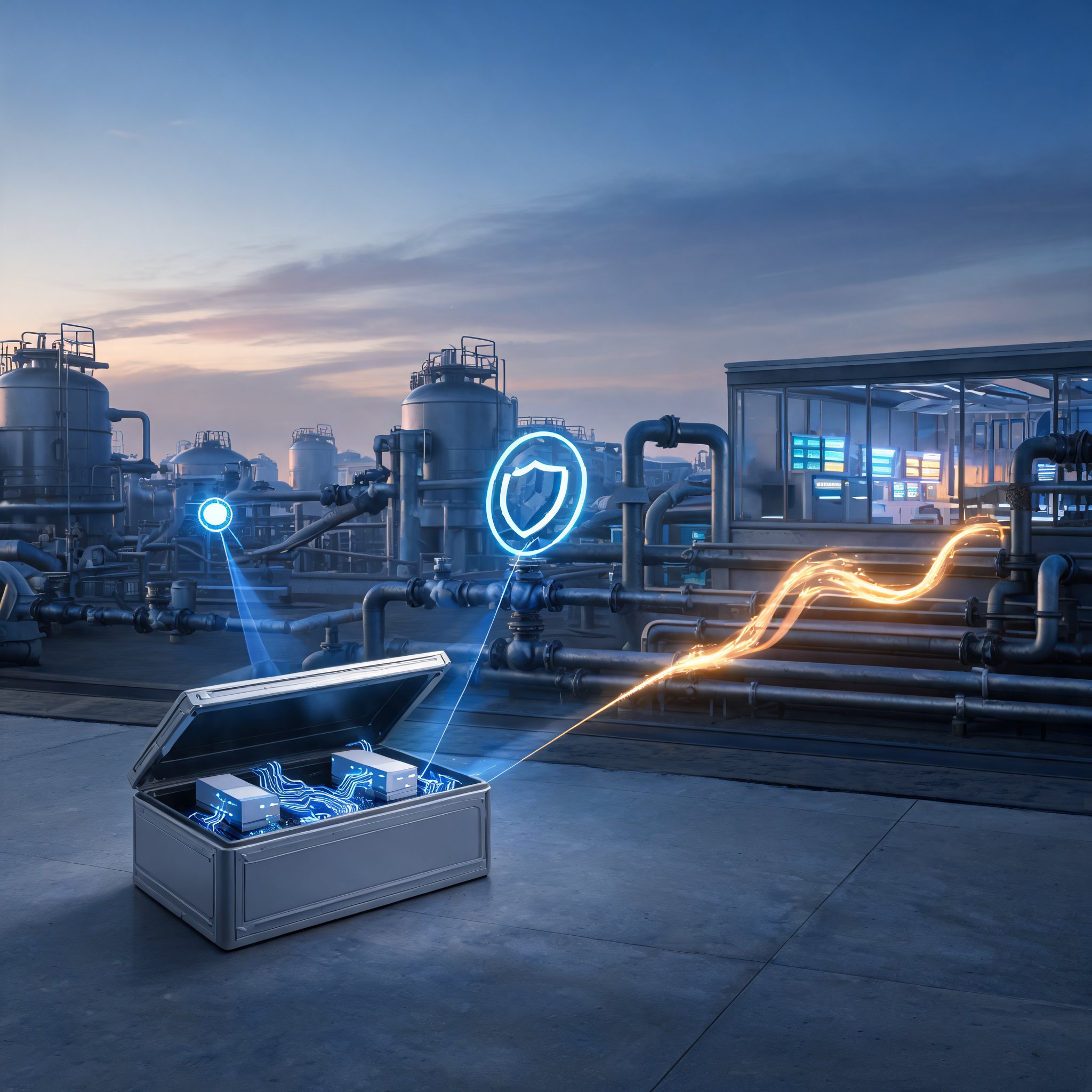
Schneider Electric has announced a strategic collaboration with NVIDIA and HPE to accelerate Physical AI adoption in process and heavy industries, starting with an initial offering called Industrial AI Agents at the Edge.
The companies say the effort addresses a gap in current Physical AI adoption. Much of today's attention focuses on robotics, humanoids and autonomous machines, while process industries run continuous operations in which reliability, safety, cybersecurity and energy efficiency are critical. According to the announcement, there has been no clear blueprint for applying Physical AI practically across these environments.
Edge architecture targets operational constraints
The solution combines HPE Private Cloud AI, co-engineered with NVIDIA within the HPE AI Factory with NVIDIA portfolio, with Schneider Electric's operational technology expertise. The companies say it is intended to let organizations deploy and scale AI applications at the industrial edge, bringing real-time intelligence closer to critical operations while retaining control over sensitive data, security and costs.
Schneider Electric says the edge approach addresses three barriers. Critical operational data can be too valuable, sensitive or regulated to move beyond operational boundaries, so local processing supports data sovereignty and compliance. Keeping data near its source also reduces the attack surface as connectivity increases. And as AI use grows, cloud-based inference, data transfer and token-related costs can rise; edge deployment may reduce some of those expenses while giving organizations more control over where workloads run.
Three initial agents, one management environment
Customers can deploy, manage and govern multiple agents through Schneider Electric's EcoStruxure Industrial Insights apps, which the company says simplifies lifecycle management and security oversight. The first three agents focus on OT monitoring, cybersecurity and energy optimization.
- OT Monitoring Agents combine real-time operational data, equipment configurations, process topology, alarms, maintenance history and engineering context to understand the physical state of operations. They identify emerging issues, assess likely impacts, recommend or initiate corrective actions and verify the expected physical outcome.
- Cybersecurity Agents correlate network activity, control-system behavior, asset configurations, operational events and process context to detect abnormal conditions. They assess potential effects, recommend or execute responses and validate that systems return to a secure and stable state.
- Energy Optimization Agents integrate process data, energy-use patterns, equipment performance, operating conditions and production requirements. They identify opportunities, recommend or implement adjustments and verify effects on energy efficiency, operational performance and sustainability.
CMPC Chile provides an operational foundation
Schneider Electric points to CMPC Chile, part of Empresas CMPC S.A. and one of Latin America's largest pulp, paper and packaging producers, as an example of the operational base for the new agents. For three years, CMPC Chile has used Schneider Electric's OTMS in production to monitor control-system health and availability across continuous pulp and paper operations. OTMS gives specialists a unified view of control systems, servers, workstations and switches, helping them identify issues earlier, diagnose problems faster and set clearer maintenance priorities.
The company describes that deployment as evidence of OTMS's value and as a foundation for future Industrial AI Agents, with the potential to speed investigation and decision-making while keeping people in control of critical actions. The announcement does not report measured results from the new agents at CMPC Chile.
Executives frame the collaboration around action
Gwenaelle Huet, executive vice president of industrial automation at Schneider Electric, said the next generation of industrial innovation will be driven by intelligence embedded directly in operations. She said the collaboration aims to turn operational data into action and improve resilience, efficiency, cybersecurity and sustainability while laying a foundation for more autonomous operations.
Sri Kodali, global head of developer relations for energy and utilities at NVIDIA, said industrial operations generate vast amounts of data, but turning it into action remains a major challenge. He said combining NVIDIA Nemotron open AI models and HPE Private Cloud AI with Schneider Electric's industrial expertise and OTMS platform allows agents to monitor, reason about and optimize operations in real time.
Matías Jory, digital and process manager in CMPC's industrial operations vice presidency, said OTMS has improved visibility into control-system health over the past three years. He said early identification of issues is critical in continuous operations, and that AI agents could help specialists investigate faster and move from insight to action while people remain in control of critical decisions.
The companies position the work as a foundation for industrial operations in which intelligent systems continuously monitor, reason about and optimize performance. Over time, they say, this could support safer, more efficient and increasingly autonomous operations across process industries. Those outcomes remain a stated goal; the announcement does not report independently verified results from the new agents.