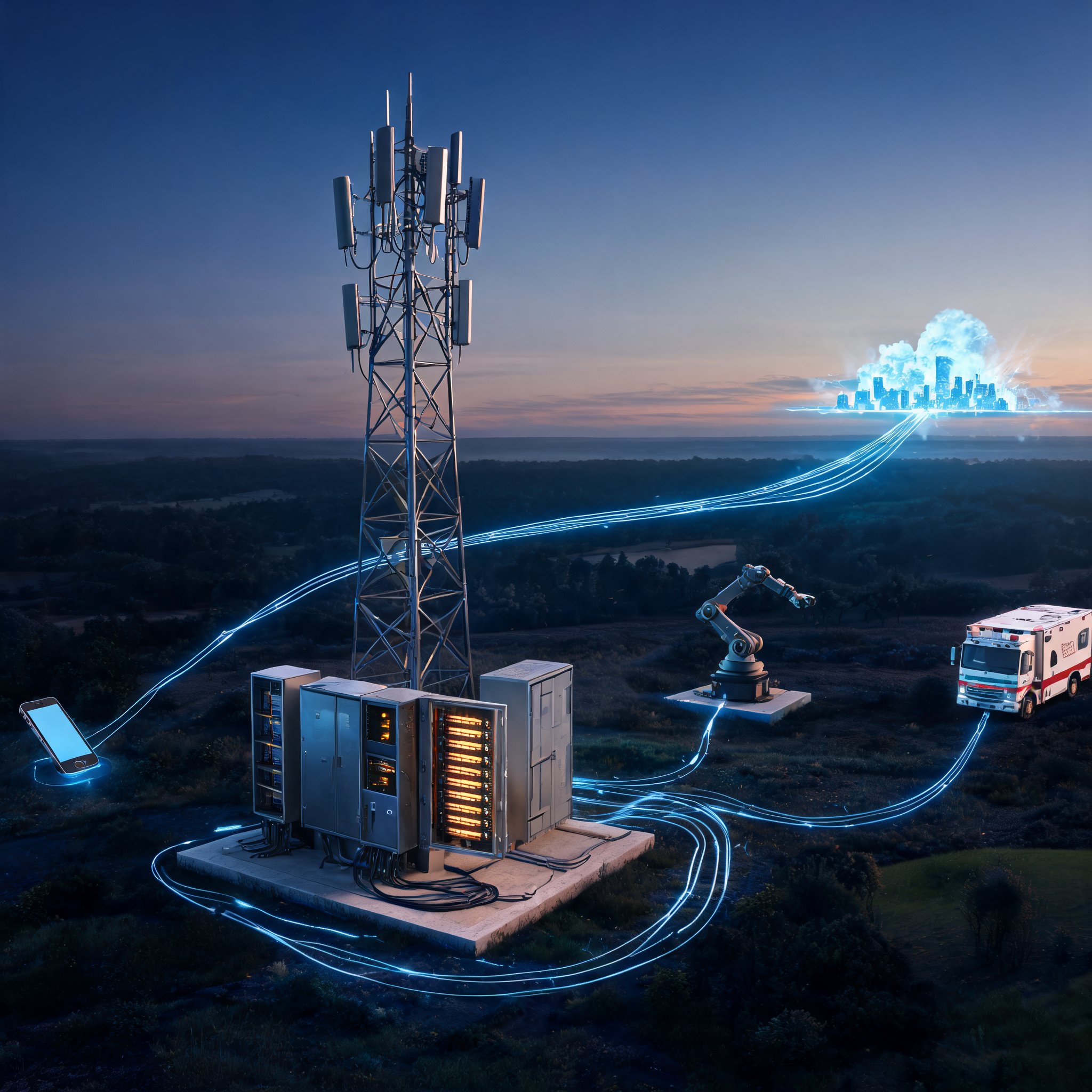
Nokia is running AI-RAN trials with BT, Deutsche Telekom, Elisa and Orange, using its anyRAN software on NVIDIA’s Aerial RAN Computer. The trial activity comes as nine operators across Europe, the Middle East and Africa are building or expanding NVIDIA-powered infrastructure.
Nearly 20 operators have publicly announced AI-RAN collaborations built on Nokia’s anyRAN software and NVIDIA’s Aerial RAN Computer. The reference stack combines CUDA, Nemotron open models and an Agent Toolkit; Nokia has embedded them into its Autonomous Networks Suite and into third-party operations software from Cisco, TCS and NTT DATA. Dell, QCT and Supermicro supply ARC-ready servers, and Red Hat OpenShift provides the cloud-native foundation.
Trials combine radio and AI workloads
Elisa has completed Europe’s first AI-RAN field trial, running voice, mobile data and vision AI together on one accelerated platform over 5G. Orange is introducing voice intelligence services for enterprises and emergency responders. Deutsche Telekom is working on physical AI for industrial customers, while BT is preparing live trials in the UK. The work is a workload mix, not a single radio feature.
The engineering rationale centres on infrastructure operators already control: land, power and shell sites, plus spectrum and fibre. Adding accelerated compute at centralised, metro and cell sites would let operators serve models closer to machinery, responders and handsets that consume them, while also allowing the radio itself to run inference.
Deutsche Telekom and Nokia lab measurements put typical uplink throughput improvement for AI-based channel estimation at about 10 to 15 percent. That is a modest return on a distributed compute build-out. Backhaul becomes the constraining variable once inference moves outward, and Nokia’s 800G coherent pluggables offer an indication of the capacity it expects operators to need between sites.
Stack shortens integration but deepens dependency
Stacking anyRAN, ARC, CUDA and Nemotron into one reference design shortens the integration path, but it also ties operators to NVIDIA’s programming model at the radio layer, with Nokia’s RAN software sitting above it. Cisco and Nokia are both folding Nemotron open models into software used to run autonomous networks, extending that dependency into operations tooling.
NVIDIA founder and CEO Jensen Huang said telecom networks were built to carry conversations and will now also carry intelligence. He described leading operators as turning land, power and connectivity into distributed AI infrastructure, with Nokia extending accelerated computing into the radio network itself to create a foundation for AI-native 5G.
Pallavi Mahajan, Nokia’s chief technology and AI officer, said the next connectivity era would be defined by networks that distribute intelligence, continuously optimise performance and enable new AI-powered services, including physical AI. She said the companies are bringing AI into the radio network and across operations, creating a software-defined foundation intended to help operators get more from spectrum while opening a path toward autonomous, AI-native 6G.
Commercial checkpoints cluster in 2027
The disclosed checkpoints cluster in 2027. BT’s Birmingham live trial is slated for then, alongside Deutsche Telekom’s field trials and Elisa’s distributed deployment with commercial AI-RAN services. Until AI-service revenue materialises, operators carry the financing for distributed compute and backhaul, while suppliers of accelerated compute and RAN software hold the layer where incremental value would accumulate.