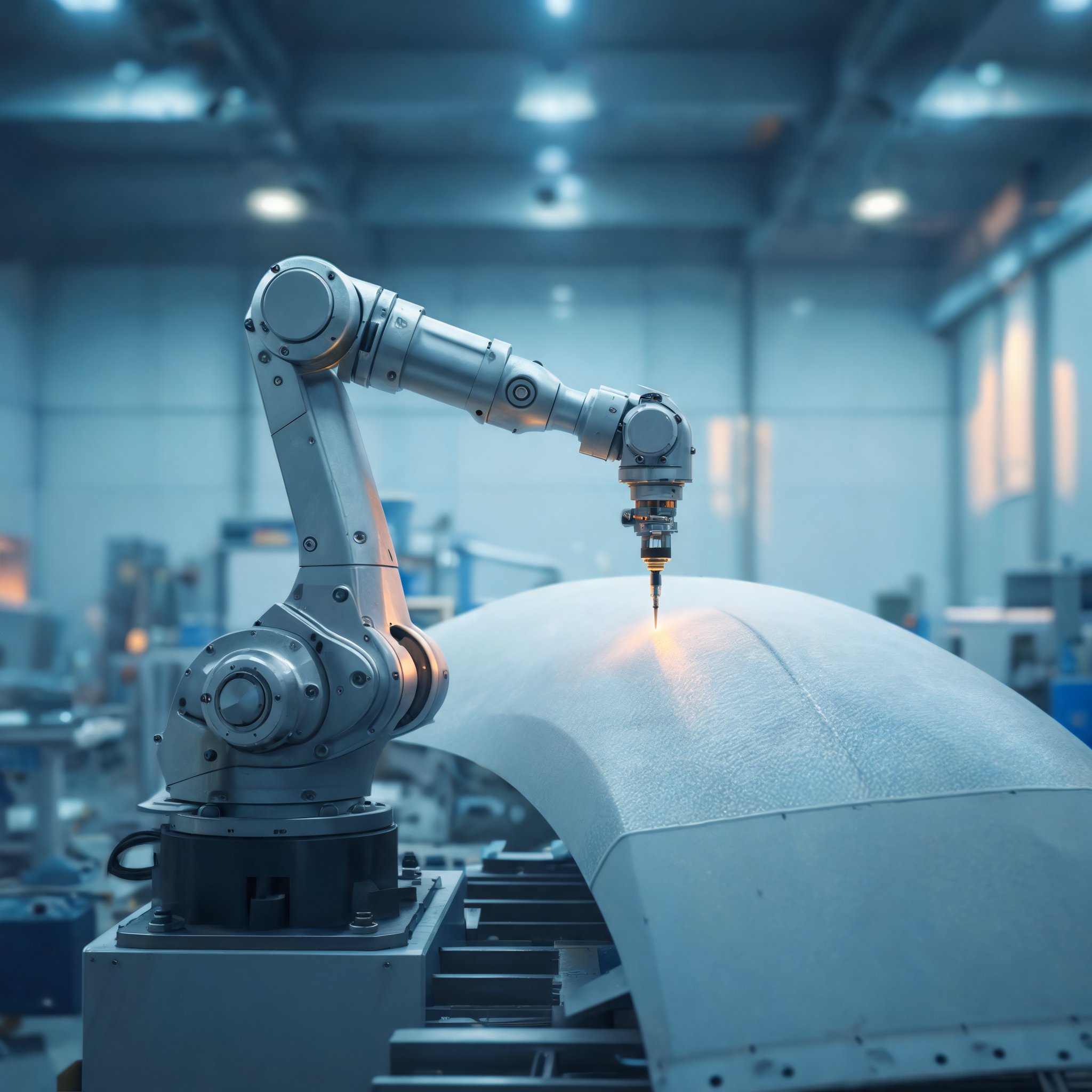
Fives High Precision Machines (Fives HPM) is offering the Liné Machines RoboTDM as an alternative to large CNC machine tools for certain large-part machining tasks. The system uses an industrial robot fitted with a specialized end effector carrying a spindle, toolholder and cutter to perform material removal directly on the workpiece. Fives says the approach can shorten set-up, simplify programming and avoid the cost and footprint of a large CNC machine when tolerances down to approximately 0.1 mm are acceptable.
Taking the tool to the workpiece
Rather than bringing an entire component into a large machine envelope, RoboTDM brings the machining capability to the part. Fives lists potential operations including face milling, deburring castings, trimming excess weld beads, drilling pilot holes in large aerospace panels or automotive body parts, and trimming, routing, drilling, edge contouring and pocketing on large composite or thermoplastic fabrications.
The company says a multi-year R&D project and development trials demonstrated cycle-time reductions of up to 70% in trimming and milling, with some individual applications achieving greater savings. Those results are presented as evidence that not every large component requires a large CNC machine; some applications mainly need a reliable, accurate way to position a cutting tool.
Closing the accuracy gap
Conventional industrial robots have typically achieved positional tolerances around 0.3 mm, which Fives says is insufficient for many machining applications. The RoboTDM development work focused on high-precision robotic machining through robot calibration, advanced look-ahead and motion-planning algorithms. Fives says these allow programs containing more than one million points to be processed without latency that could otherwise compromise robot motion, producing smoother trajectory execution and supporting multi-axis contouring and complex machining operations more comparable with CNC work.
Fives states that RoboTDM can reduce machining deviation to about 100 μm (0.1 mm), a threefold improvement over conventional robotic accuracy. The system is not positioned as a replacement for all CNC machining: where tolerances tighter than 0.1 mm are required, Fives says a high-precision CNC machine remains the appropriate choice.
Configurable hardware and applications
The machining end effector can be configured with different spindle sizes, power ratings, torque and speed. Available systems can provide spindle power up to 125 kW, torque up to 80 Nm and speeds reaching 30,000 rpm, with HSK A63, HSK F63 or HSK A100 taper toolholders. RoboTDM can also incorporate automatic tool changing, tool measurement, tool-breakage detection and part probing, while a vision system can support drilling applications. Beyond machining, the platform can be configured for waterjet cutting, laser profiling and ultrasonic cutting.
Fives says the robot's physical flexibility is useful for components too large or awkward to move through a conventional machine tool. RoboTDM can be configured with multiple workstations and customized peripheral equipment, and its relatively modest foundation requirements simplify installation compared with a large CNC machine. The company identifies aerospace, defense, maritime and energy as sectors where substantial component dimensions and varying production requirements could make the approach attractive.
RoboTDM is described as complementary to Liné Machines' and the wider Fives HPM portfolio of high-precision machine tools. Fives links the system to its “precision at scale” cross-brand message and to the integration of specialist capabilities under the Fives HPM banner. Fives Liné Machines Inc, based in Granby, Quebec, Canada, has had a North American presence for almost 50 years and produces Liné CNC machine tools and robotic solutions, including RoboTDM, along with engineering, integration, automation, service and training support.
For suitable components, Fives says RoboTDM can mean lower capital investment, simpler installation, greater flexibility and shorter cycle times, placing it between conventional robotics and the cost of a large CNC machine tool.