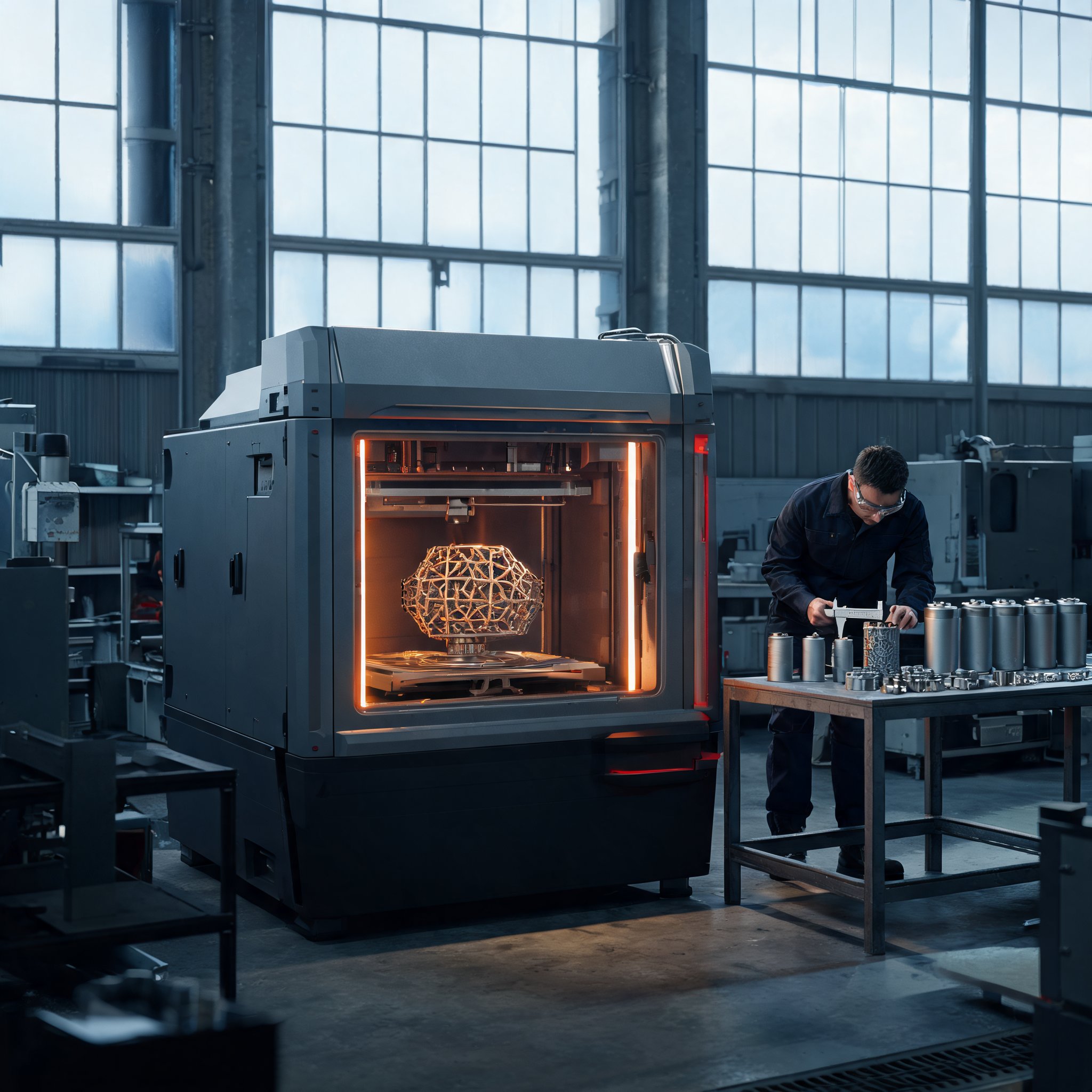
Britain’s additive manufacturing sector enters Formnext 2026 with a familiar advantage and a familiar question. The UK is partner country at the Frankfurt fair from 17 to 20 November, and its research base in metallurgy, materials science and machine technology is substantial. The commercial test is different: who buys the machines, qualifies the processes and places repeat orders?
That question is older than additive manufacturing. Portsmouth Dockyard’s block-making machines, designed by Marc Isambard Brunel and built by Henry Maudslay, began operating in 1803. The Admiralty approved another set for smaller blocks that May; by 1808, 45 machines produced 130,000 blocks. The Royal Navy knew the sizes and quantities it used and could watch the first machines work before committing to the next set. Demand was specific, visible and repeatable.
Invention is measurable; production is not
The European Patent Office counted 1,925 international additive manufacturing patent families originating in the UK between 2001 and 2020, close to France’s 1,938. Additive Manufacturing UK put the UK market at £515m to £740m in 2024, or 3% to 4.3% of the global total. The range reflects disagreement between estimates. Neither measure shows how much production takes place in Britain.
Wayland Additive illustrates the distinction. Its Calibur3 metal system left Huddersfield for the University of Innsbruck in October, where Austrian researchers will study difficult materials, including high-temperature ones. Britain built and exported the machine; some knowledge of what can be done with it will accumulate in Austria. Alloyed, meanwhile, licensed a cast nickel alloy to Hitachi Metals in 2018, opened facilities in Abingdon and Seattle, and sold its first flight parts from Seattle in 2023. Patent statistics record where an invention originated, not where the next component order goes.
The installed base and the cost of learning
Will Richardson, chief executive of Wayland, points to a practical constraint: ‘if you’re not actually doing the doing, then you’re not going to get good at it.’ A limited installed base means fewer customers putting work through machines and fewer experienced operators to recruit. A CNC machinist can learn to run an additive system, but where several factories use the equipment, employers can hire people who already prepare builds and keep machines productive. With a small base, each firm trains more itself.
Qualification adds another cost. Fastech managing director Jason Hutt notes that casting is already approved. An additive replacement may pass material tests yet still need evidence specific to the equipment, process and grade a customer specifies; a second buyer may ask for much of that work again. The cost must come from orders eventually won, and the arithmetic for fifty parts differs from five thousand. The £38m Airbus-led DECSAM programme, with Renishaw, GKN Aerospace, Apex, the Manufacturing Technology Centre and others, plans ground and flight demonstrators and qualification guidance. It lets suppliers learn a major customer’s requirements while processes are developed, but a production contract remains a separate buyer decision.
Funding a project is not funding a business
Rapid Fusion co-founder Jake Hand says the Exeter company is profitable without R&D funding, but Innovate UK support helped it develop technology and share costs with partners. His criticism concerns the moment a project succeeds: ‘they back a project, but not a business.’ A finished project may leave a working machine and evidence for funders, while the customer asks whether it can make a particular mould, who will train the operator and what happens if a job stops halfway. Answering those questions for one sale can take months. Later-stage Innovate UK funding can cover customer validation, initial tooling and production preparation, but not general business costs.
University spin-outs face ownership and capital questions alongside technical ones. Hydra Manufacturing, a Leeds spin-out developing technical ceramics equipment, announced £320,000 in equity led by SFC Capital in March and had secured about £577,000 including earlier grants; it was considering raising around £1m or more. Founder Louis Masters recognises that two more installations would give investors a stronger signal than encouraging emails, but winning those customers competes for time with fundraising. At Wolverhampton, John Robinson recalls an earlier technology-transfer proposal for 75% of his company and more recent discussion of a 10% stake. Royal Academy of Engineering and Dealroom data show average non-cash university stakes in UK deep-tech hardware spin-outs falling from 25% in 2015–19 to 14% in 2024–25.
Demand, procurement and repeat orders
The customer side is not only about price. CloudNC chief operating officer Jason Bowes said at a House of Lords briefing that it is ‘far, far easier’ to sell the company’s AI-assisted CNC programming software in the US than in Britain. A cautious machining business with an uncertain order book may see little comfort in a process that lowers cost per part at full utilisation if it can fill only a fraction of its hours. The calculation changes when a customer commits to volume, pays for qualification or has a problem expensive enough to justify investment.
AMufacture shows how service can hold production locally. Craig Pyser, its chief executive and chair of Additive Manufacturing UK, estimates 95% to 98% of its work is now production, with defence its largest sector and marine and automotive also significant. Defence customers may revise designs every six to eight weeks; a local manufacturer able to take the revised file and deliver the next batch can win repeat orders while the product changes. When one customer took some production in-house, AMufacture helped it run the printer, but the customer kept ordering and two years later sold the machine back. Software, staff and post-processing had made in-house operation more expensive and demanding than expected.
Public purchasing could shape demand, but only if it is specific. The Manufacturing Technologies Association’s James Selka told the Lords briefing that investment needed a proper demand signal and co-investment from government. Lord Harrington, chair of Make UK, recalled that aerospace and life-sciences sector deals had companies able to match public money, while some other manufacturers could scarcely afford their share. He also described GeoPura, which tried to raise further capital in Britain and ended up selling to Canada’s Ballard Power Systems for £275m upfront.
Fusion procurement shows both the opportunity and the limit. In 2025 the UK Atomic Energy Authority commissioned a Freemelt electron-beam system for tungsten work and a Nikon SLM laser supplied by Kingsbury Machine Tools with support from Additure at its Central Support Facility. A British public institution thus gained access to equipment from international manufacturers. UKAEA also reports British participants, including Laser Additive Solutions, The Welding Institute and WAAM3D, in separate fusion maintenance work. For a machine builder such as Wayland, the relevant question is when the next equipment specification is drawn up; for a repair specialist, whether development leads to a maintenance contract. UKAEA’s quarterly procurement pipeline distinguishes possibilities over one to five years, pre-commercial work and confirmed requirements expected to go to tender. Even a confirmed tender is still some distance from a repeat order.
The UK’s additive manufacturing gap is therefore not a single failure of invention. It is a chain of commercial links: domestic installed capacity, shared qualification costs, customer validation, spin-out ownership, procurement timing and repeat orders. Researchers at Added Scientific also distinguish established single-material processes from multi-material devices that still need to prove they work, cautioning against treating all additive manufacturing as one mature technology. Pyser proposes a simple test for Formnext: an overseas company choosing Britain for a European base would count. Smaller follow-ups matter too. Did a visitor who saw a British-built machine order one? Did a first installation lead to a second? Britain’s research base can supply technology; the harder work is creating visible, repeatable demand that turns it into production experience.