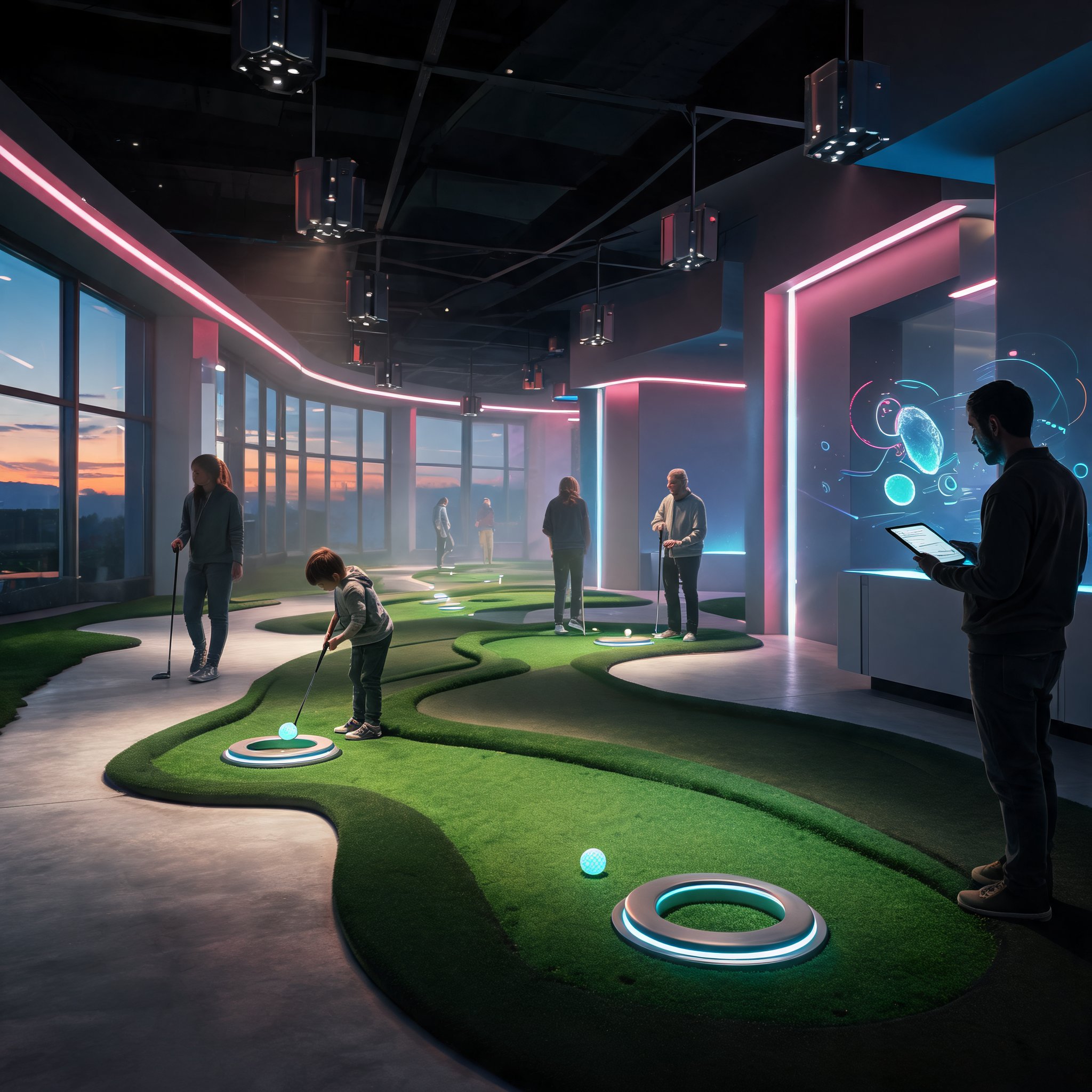
Holovis’ 360Golf is not trying to replace mini golf with a new entertainment category. It is turning the familiar putting format into a connected game platform: smart equipment handles scoring, a software layer adds challenges and player history, and an analytics engine gives operators another view of how the venue is performing. The company is preparing to present the system at IAAPA Expo, with installations already spread across the UK, Europe, the Middle East, North America and Asia Pacific.
The familiar course as a platform
The starting point is deliberately conventional. A visitor registers, receives a smart ball and begins playing. The low instruction burden matters for venues because staff do not have to coach every group through the format. HoloTrac, working with smart balls, tees and cups, removes paper scorecards and provides an automatic record of play. That record becomes the base for the rest of the product.
On top of scoring, 360Golf adds a set of game mechanics: SuperShots that create alternative ways to score, Triumphs that award achievements and unlock challenges, bonuses, on-course games, player accounts, leaderboards and video celebrations. The company’s argument is that these features give players more reasons to compete, celebrate and compare results, and therefore more reasons to return. For operators, the same features create a visitor profile that can be used to shape repeat visits rather than treating mini golf as a one-off attraction.
Data changes the operating model
DeepSmarts, Holovis’ analytics engine, is the operational layer. The company says it can give operators insight into how players interact with the course, seasonal patterns, uptime and potential operational changes. Holovis can also use the data to support product development and offer additional services. The commercial logic is to raise dwell time and secondary spend while keeping the check-in process simple. With capacity described as up to 80 people per hour per course, the system is designed to move groups through without consuming staff time at the tee.
That makes the food-and-beverage opportunity part of the pitch. If guests can register and start playing with little assistance, staff can concentrate on hospitality and service. The company also says the data can help operators schedule promotions in quieter periods or target audiences that are not being reached. Maintenance is part of the same design: 360Golf is described as robust and repairable, and remote diagnostics can help engineers identify faults. These are operational claims from the supplier rather than independently audited outcomes, but they show where the platform is meant to create value beyond the game itself.
Modular delivery, different venues
The platform is offered in several formats. Tech-only packages can be retrofitted into existing mini golf attractions, catalogue holes provide a tested design, and fully custom courses are built around a venue or intellectual property. The company cites installation schedules of roughly six to eight weeks for tech-only deployments, eight to 12 weeks for off-the-shelf catalogue holes and six months or more for custom builds. That range is important because it lets 360Golf address two different markets: operators who want to upgrade an existing course quickly, and developers who need a bespoke anchor attraction.
Recent examples show the spread. At Netflix House, the Top 9 course is a custom, IP-led installation with holes themed around One Piece, Squid Game and Floor is Lava. For Norwegian Cruise Line, the Tee Time installations use marine-grade, waterproof equipment and rugged cups and tees for use at sea. Super Social in Leopardstown, Ireland, uses 12 holes from a sports-themed package. A project for Lucky Duck in Norway gives each hole two play routes. For multi-site operators such as Saudi Entertainment Ventures, the core technology can provide consistency while theming, layout or branding vary by location. Smaller venues can choose a simpler or more cost-effective course while retaining scoring and replayability.
Inclusive design and a commercial test case
Butlin’s PLAYXPERIENCE in Bognor Regis is the clearest operator example cited. The £15m indoor activity centre opened in 2024 with three nine-hole 360Golf courses: a neon-glow course, a Las Vegas-themed course and a wheelchair-accessible music-themed course. The company says the attraction has exceeded the client’s expectations, with 5,000 players in a busy week and around £40,000 in weekly revenue. Those figures are supplier-reported and should be read as a performance claim, not an independent benchmark.
The project also illustrates how inclusive design affects the physical product. The team describes attention to right- and left-handed play, putter sizes for taller guests, wheelchair access through a drop-down top cap, tees positioned close to the edge and spacing between holes to reduce crowding and safety hazards. These details are not peripheral. They determine whether the platform can serve families, older guests and mixed-ability groups, which is central to the intergenerational appeal the company is selling.
Where the proposition still has to prove itself
360Golf’s advantage is not technology in isolation. The visual and physical course design, lighting, theming and build quality remain part of the attraction, and custom or IP-driven projects feed new learning back into the product. The company is also looking beyond mini golf: it is working with Roxy Leisure on stroke-counting technology for crazy pool tables and says it wants to apply its technology to other sports. Those efforts indicate ambition, but they are development and integration work rather than evidence that the model transfers easily to every recreation format.
The main test is commercial. A connected course can generate data and repeat play, but operators still need the right location, audience mix, throughput and hospitality operation to convert visits into revenue. The company itself expects competitive socialising to reach saturation and is exploring adjacent markets. For now, 360Golf’s proposition is clear: make a familiar game measurable, modular and easier to operate. Whether that produces durable returns across cruise decks, multi-site entertainment hubs and smaller venues will depend on execution at each site, not on the scoring system alone.